July 28, 2026 · By Annanya Adyasha
What a Wellness SEO Agency Actually Does
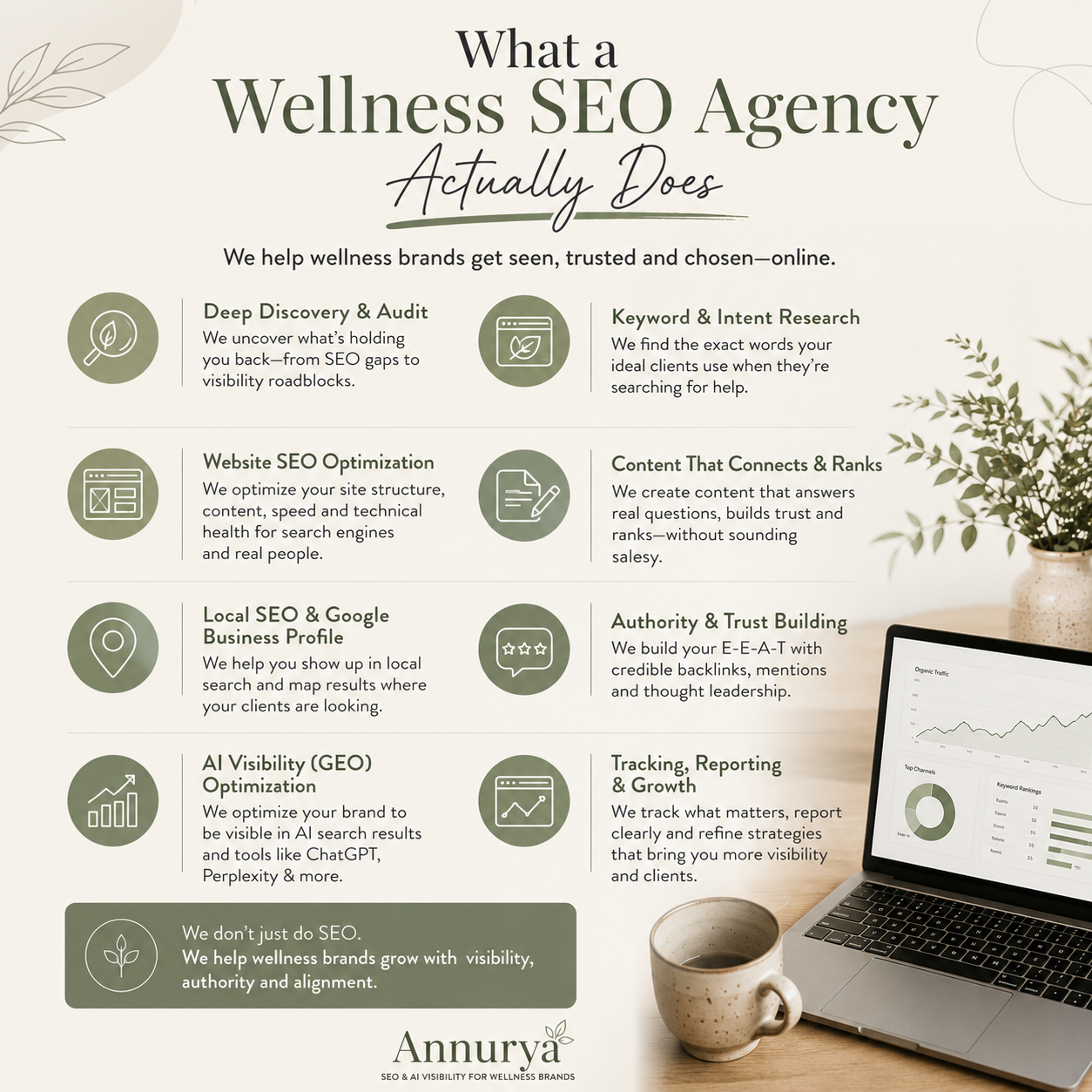
"Wellness SEO agency" gets thrown around a lot, but most people searching that phrase are really asking one question: what am I actually paying for? A wellness SEO agency is a marketing partner that specialises specifically in ranking health and wellness practitioners on Google and, increasingly, in AI-generated answers — not a general digital marketing shop that happens to take wellness clients. Understanding the difference before you hire one saves months of wasted budget.
Why "Wellness" Is a Real Specialism, Not a Label
Google treats health-adjacent content under its strictest quality framework — Your Money or Your Life (YMYL) content gets more scrutiny than almost any other category. A wellness SEO agency understands this from day one: E-E-A-T signals, credential display, and evidence-informed language aren't optional extras, they're the foundation everything else is built on. A generalist agency applying an eCommerce or SaaS playbook to a therapist's website usually misses this entirely, and the gap shows up as flat rankings within a few months.
What a Wellness SEO Agency Actually Delivers
In practice, a competent wellness SEO agency covers: a technical audit and fix pass (speed, indexing, schema), keyword research built around how wellness clients actually search, on-page content that satisfies both search engines and a nervous first-time visitor, Google Business Profile management for local visibility, and increasingly, AI visibility work — making sure ChatGPT and Gemini can find and cite you when someone asks for a recommendation. A serious wellness SEO agency treats all of these as one connected system, not a menu of unrelated add-ons.
How to Tell a Good One From a Generic Shop
Ask three questions before signing anything: Do they have wellness-specific case studies, or just logos from unrelated industries? Do they understand YMYL and E-E-A-T without you having to explain it? Do they offer AI visibility (GEO) as a real, built-in part of the strategy, or as an untested add-on? A wellness SEO agency worth hiring should answer all three without hesitation, and should be able to point to specific ranking movement for practitioners in your exact niche.
What This Looks Like by Market
The right approach also shifts by country. A wellness SEO agency working in Australia needs to understand AHPRA-adjacent trust signals and local suburb-level competition; one working in the UK needs to know BACP and HCPC registration conventions. See our full Wellness SEO service for how we handle this market by market, rather than applying a single template everywhere.
Common Mistakes When Hiring a Wellness SEO Agency
The most common mistake is choosing on price alone without checking whether the agency has actually ranked practitioners in your specific niche. The second most common: signing a long contract before seeing a technical audit of your current site, which should always come first. A genuine wellness SEO agency will want to audit before quoting a full strategy, not the other way round.
Getting the Timeline Expectations Right
Most clients working with a competent wellness SEO agency see measurable ranking improvement within 60 to 90 days on lower-competition terms, with more contested city-wide terms taking four to six months. Anyone promising page-one rankings in two weeks is not describing how a this's work actually unfolds, and that promise alone is worth treating as a warning sign.
How to Measure Whether This Is Working
Track three numbers monthly rather than checking daily: total impressions in Google Search Console (a leading indicator that Google is testing your content against more queries), average position for your two or three priority terms, and actual click-throughs once positions start improving. Early-stage SEO work often shows impressions rising well before clicks do — that's a sign of progress, not a plateau, provided positions are also trending in the right direction over each four to six week window. Resist the urge to judge results weekly; ranking data is noisy over short windows and settles into a clearer trend only once a month or so of data has accumulated.
What a Realistic 90-Day Plan Looks Like
The first two to three weeks typically go to a technical and content audit, establishing a clear baseline before anything changes. Weeks three through six focus on foundational fixes and the highest-priority page or two. From there, content expands steadily on a fortnightly or monthly cadence rather than all at once, so early performance data can shape what gets built next rather than guessing upfront. By day ninety, most practices have a noticeably stronger technical foundation, several new or substantially improved pages, and enough performance data to make an informed decision about where to invest the following quarter's effort.
Where This Fits Into a Complete Strategy
None of this works well in isolation — technical health, content depth, local presence and AI visibility all reinforce each other rather than functioning as separate checkboxes. See our Wellness SEO service and case studies for how these pieces come together for practitioners already doing this well. The practices that see the fastest, most durable movement are almost always the ones treating this as one connected system rather than picking a single tactic and hoping it carries the whole strategy on its own.
What to Ask Before Committing Budget
Before committing meaningful budget to any of this, ask for a technical audit first, ask what a realistic 90-day outcome actually looks like given your specific starting point and market, and ask how progress will be reported to you in plain language rather than raw data exports. A partner unwilling to answer these clearly before being paid is worth reconsidering, regardless of how confident the initial pitch sounds.
The Long View Beyond the First Quarter
Most of the compounding value in this kind of work shows up after the first 90 days, not during it — content published early keeps earning rankings and citations for years afterward, and the technical foundation built early makes every future page easier to rank, not just the ones published this quarter. Treating the first quarter as a foundation-building phase rather than a finished result tends to set expectations that hold up well over the following year, and avoids the common trap of judging an entire strategy on its slowest-moving first few weeks.
Frequently Asked Questions
Is a this more expensive than a general marketing agency?
Not necessarily — pricing depends on scope, not niche. What you're paying for with a this is not having to explain your industry from scratch, and not risking generic advice that ignores YMYL requirements.
How long has "wellness SEO" been a distinct specialism?
It's grown significantly since Google's E-E-A-T guidelines started being applied more strictly to health-adjacent content, making generalist SEO advice increasingly risky for practitioners.
Do I need a this if I'm a solo practitioner?
Solo practitioners often benefit the most from a this, since they rarely have in-house marketing support and a specialist agency can move faster without needing the niche explained.
What's the difference between a this and a healthcare marketing agency?
Healthcare marketing agencies typically serve hospitals, clinics and large medical groups. A this more often serves individual coaches, therapists and nutritionists with different budgets and different search behaviour.
Can a this also help with AI visibility?
A good one should. AI visibility (getting cited by ChatGPT, Gemini and Perplexity) increasingly sits alongside traditional SEO rather than as a separate service.
How do I know if my current agency understands YMYL content?
Ask them directly what E-E-A-T and YMYL mean for your specific content. If the answer is vague, that agency probably isn't a genuine this, just a generalist taking wellness clients.
Should a this write my content for me?
Most do, but the best ones build content around your actual voice and case studies rather than generic templates with your name inserted.
Is local SEO part of what a this does?
Yes, for any practitioner seeing in-person clients. Google Business Profile management and local citation building are core, not optional, parts of what a proper this delivers.
What results should I expect in the first 90 days?
Most clients see measurable ranking movement within 60 to 90 days on lower-competition terms, with more competitive city-wide terms taking longer.
Do wellness SEO agencies work internationally?
Many do, though the best ones adapt strategy market by market rather than applying one country's playbook everywhere — a hallmark of a genuinely capable this.