July 30, 2026 · By Annanya Adyasha
SEO for Coaches in Australia: The Complete Guide
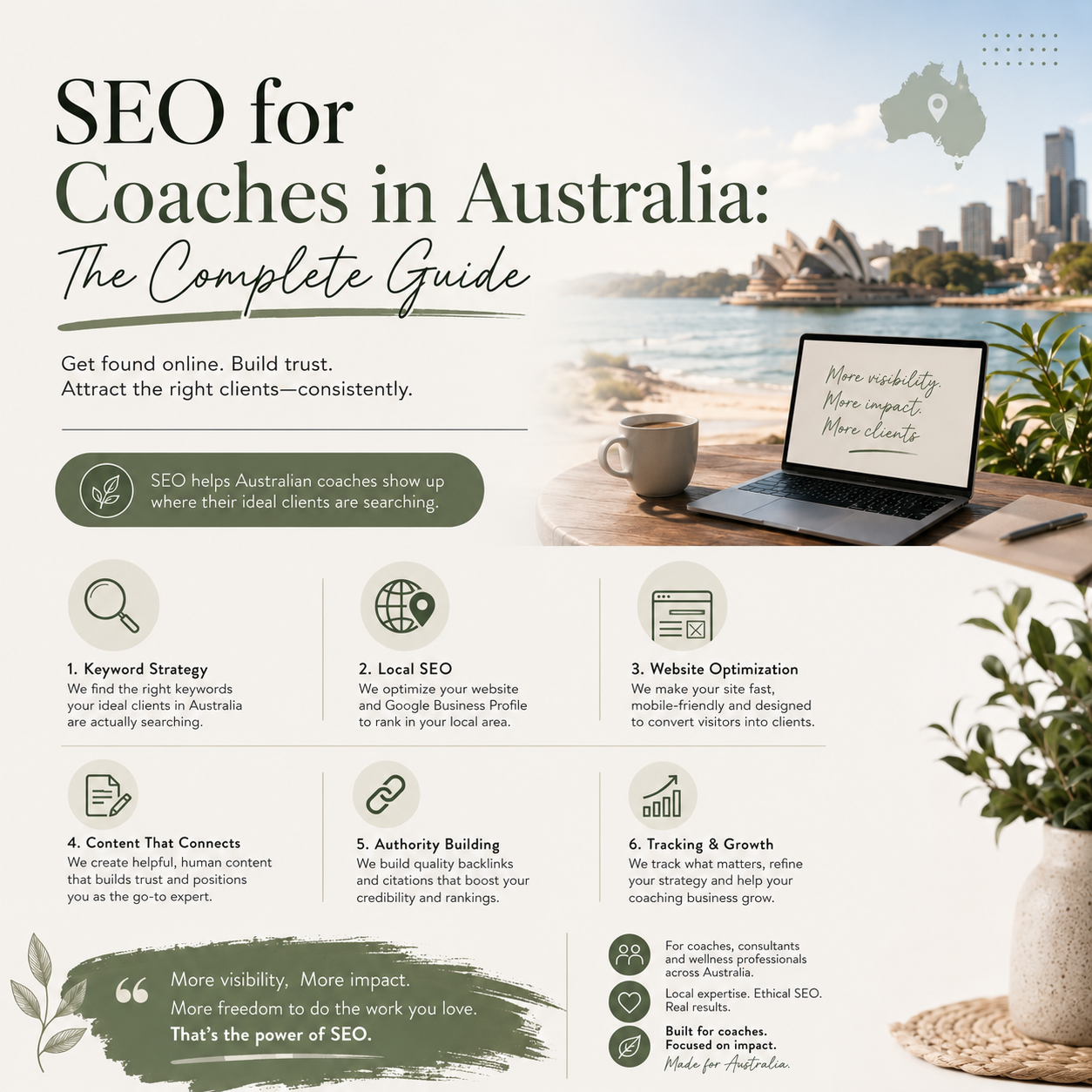
SEO for coaches in Australia looks different to the US or UK playbook most generic agencies default to. Australian search behaviour, review culture, and local competition all shift the strategy — and getting this wrong is the single biggest reason otherwise good coaches stay invisible on Google in their own city. This guide walks through what SEO for coaches in Australia actually involves once you strip away the generic advice.
Why Generic SEO Advice Underperforms in Australia
Most content about SEO for coaches in Australia is written for the US market and lightly reworded. Australian clients search differently — "near me" intent is stronger, Australian English spelling matters more than most coaches realise, and directory citations that carry weight in the US (Healthgrades, Yelp) carry almost none here. True Local, Yellow Pages AU, and Healthengine matter far more for coaches building genuine local presence.
City-by-City Differences That Actually Matter
SEO for coaches in Sydney is a different competitive environment to Perth or Adelaide. Sydney and Melbourne carry the heaviest competition; Brisbane and Perth still have real openings in specific suburbs. We break this down suburb by suburb in our Australia market page, including growth corridors like Baldivis, Harrisdale and Piara Waters where competition is currently low relative to demand.
What Actually Moves the Needle
For most coaches, three things drive movement fastest: a properly categorised Google Business Profile, suburb-specific content rather than one generic "Australia" page, and consistent NAP (name, address, phone) data across Australian directories. Generic keyword stuffing on a single homepage rarely outranks a coach who has invested in three well-built suburb pages instead.
Who This Applies To
This applies across the coaching spectrum — wellness and mindfulness coaches, fitness trainers, and increasingly ADHD and neurodivergent-affirming coaches, a fast-growing and currently underserved category within SEO for coaches in Australia specifically.
Common Mistakes Coaches Make Here
The most common error is treating SEO for coaches in Australia as identical to the US market and simply swapping the country name in copy. The second most common: ignoring Google Business Profile entirely in favour of blog content, when for most in-person coaches the local pack drives more bookings than organic articles ever will.
A Realistic Timeline for Results
Suburb-specific searches within this often move within eight to twelve weeks with a properly optimised profile and citations. City-wide terms in Sydney or Melbourne typically take four to six months given established competition — a timeline worth setting expectations around from day one.
How to Measure Whether This Is Working
Track three numbers monthly rather than checking daily: total impressions in Google Search Console (a leading indicator that Google is testing your content against more queries), average position for your two or three priority terms, and actual click-throughs once positions start improving. Early-stage SEO work often shows impressions rising well before clicks do — that's a sign of progress, not a plateau, provided positions are also trending in the right direction over each four to six week window. Resist the urge to judge results weekly; ranking data is noisy over short windows and settles into a clearer trend only once a month or so of data has accumulated.
What a Realistic 90-Day Plan Looks Like
The first two to three weeks typically go to a technical and content audit, establishing a clear baseline before anything changes. Weeks three through six focus on foundational fixes and the highest-priority page or two. From there, content expands steadily on a fortnightly or monthly cadence rather than all at once, so early performance data can shape what gets built next rather than guessing upfront. By day ninety, most practices have a noticeably stronger technical foundation, several new or substantially improved pages, and enough performance data to make an informed decision about where to invest the following quarter's effort.
Where This Fits Into a Complete Strategy
None of this works well in isolation — technical health, content depth, local presence and AI visibility all reinforce each other rather than functioning as separate checkboxes. See our Wellness SEO service and case studies for how these pieces come together for practitioners already doing this well. The practices that see the fastest, most durable movement are almost always the ones treating this as one connected system rather than picking a single tactic and hoping it carries the whole strategy on its own.
What to Ask Before Committing Budget
Before committing meaningful budget to any of this, ask for a technical audit first, ask what a realistic 90-day outcome actually looks like given your specific starting point and market, and ask how progress will be reported to you in plain language rather than raw data exports. A partner unwilling to answer these clearly before being paid is worth reconsidering, regardless of how confident the initial pitch sounds.
The Long View Beyond the First Quarter
Most of the compounding value in this kind of work shows up after the first 90 days, not during it — content published early keeps earning rankings and citations for years afterward, and the technical foundation built early makes every future page easier to rank, not just the ones published this quarter. Treating the first quarter as a foundation-building phase rather than a finished result tends to set expectations that hold up well over the following year, and avoids the common trap of judging an entire strategy on its slowest-moving first few weeks.
Frequently Asked Questions
How long does this take to show results?
Suburb-specific terms often move within 8 to 12 weeks. City-wide terms in Sydney or Melbourne can take 4 to 6 months due to established competition.
Is Google Business Profile more important than website SEO for coaches?
Both matter, but for in-person coaching, Google Business Profile often drives faster local pack visibility while website SEO builds longer-term authority.
Do Australian clients search differently to US or UK clients?
Yes — "near me" and suburb-specific searches dominate more heavily, and Australian English spelling and tone noticeably affect trust signals.
Which Australian directories actually matter for coach SEO?
True Local, Yellow Pages AU, Healthengine and HealthShare carry real local weight. US-centric directories carry little to none.
Is this different to SEO for therapists?
The underlying principles overlap, but therapists face stricter YMYL scrutiny and often need professional body registration displayed prominently.
Should I target Sydney and Melbourne if I coach nationally?
Only if you genuinely serve those specific markets — otherwise a national strategy with select suburb pages performs better than spreading thin.
What's the fastest-growing, lowest-competition market in Australia right now?
Southern Perth corridor suburbs like Baldivis, Harrisdale and Piara Waters currently show strong demand growth with comparatively little SEO competition.
Do reviews matter more in Australia than other markets?
Review depth and recency matter significantly, particularly in denser competitive suburbs and inner-city areas.
Can I do this myself without an agency?
Yes, especially early on — the fundamentals (GBP setup, suburb pages, citations) are learnable, though the compounding effort of consistent execution is where most coaches run out of time.
Does neurodivergent-affirming coaching have specific SEO considerations in Australia?
Yes — this is a growing, underserved niche in the Australian market with distinct search language and trust signals compared to generic wellness coaching.