July 9, 2026 · By Anurag Paul Gummadi
SEO for AuDHD-Informed Clinicians: A Different Search Pattern Than General Therapy SEO
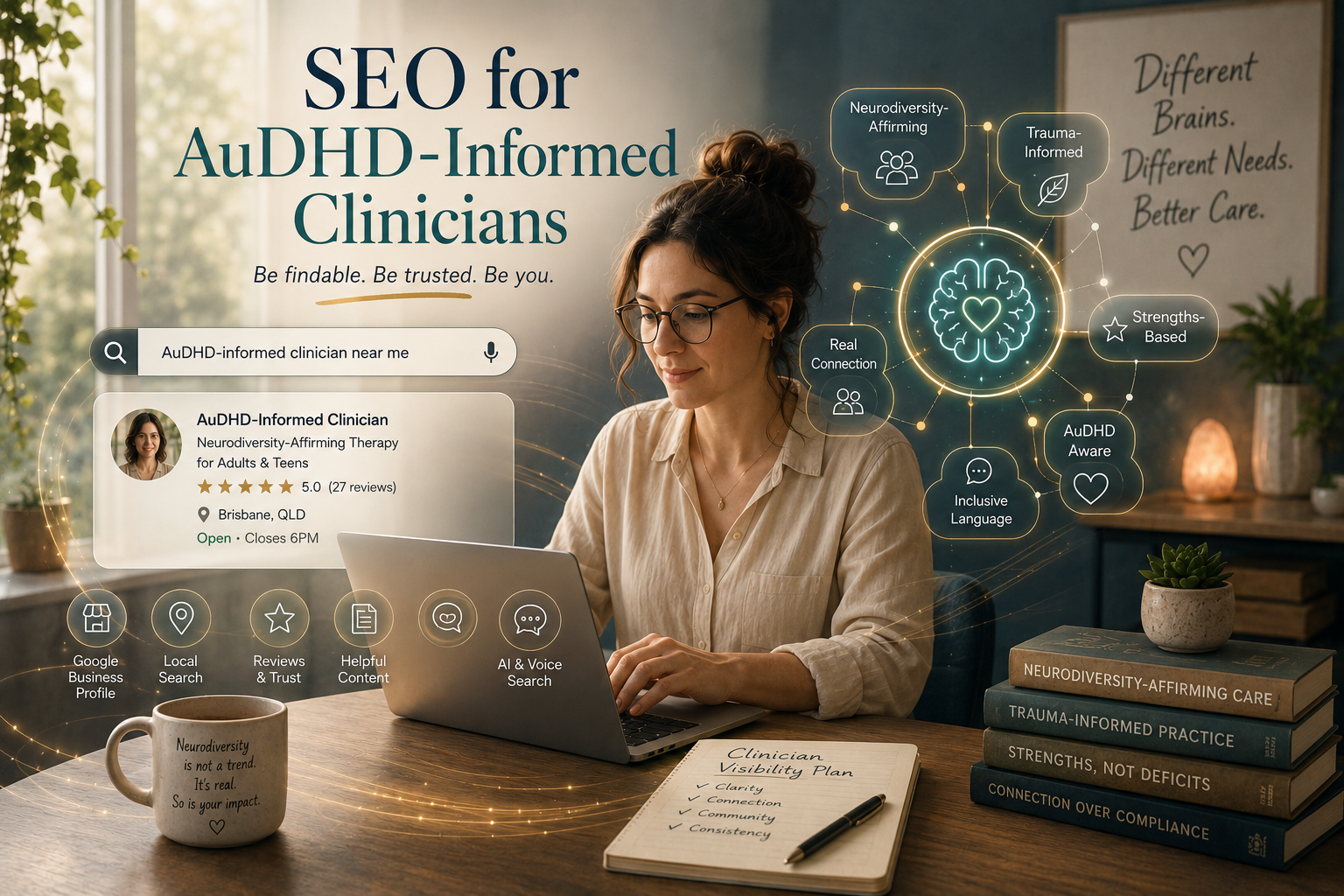
AuDHD — the co-occurrence of autism and ADHD — is one of the fastest-growing self-identification and diagnostic categories in mental health, yet almost no AuDHD clinician marketing content exists that treats it as its own search category rather than folding it into general autism or ADHD content. That gap is exactly the opportunity this article maps out.
For clinicians who already work with AuDHD clients but market themselves under a general "neurodivergent-affirming" umbrella, this article makes the case for being more specific — and shows exactly how to do it without fragmenting your broader positioning.
Who Benefits Most From This Specific Strategy
This approach is most valuable for clinicians who already have meaningful clinical experience working with AuDHD clients but haven't yet built dedicated marketing content around that specific expertise, often because their site's content structure grew organically around single-condition categories rather than being planned around this specific overlap from the start.
It's also relevant for clinicians earlier in building this specialization, who recognize growing client interest in AuDHD-specific support and want their marketing to reflect and anticipate that demand rather than lag behind it.
Why This Content Gap Persists Even as Awareness Grows
Public awareness of AuDHD as a distinct experience has grown substantially in recent years, driven largely by adult self-identification communities and increased clinical attention to co-occurring diagnoses. Content production, however, has lagged behind this awareness shift, since most clinical marketing content still gets organized around single-condition categories inherited from how insurance billing and diagnostic coding traditionally separate autism and ADHD.
This structural lag creates the exact opportunity this article is built around: demand has outpaced supply of genuinely dedicated content, and that imbalance tends to correct more slowly in a specialized clinical niche than it would in a faster-moving consumer category, giving early movers a longer runway.
Clinicians who've noticed this gap in their own practice — clients mentioning that they couldn't find content that addressed both conditions together — are often sitting on exactly the kind of first-hand insight needed to build genuinely differentiated content, more so than a generic content strategy built from keyword research alone.
Why AuDHD Search Behaviour Differs From Either Condition Alone
Clients searching for AuDHD-informed care are often looking for someone who understands the specific tension between autistic and ADHD traits — for example, a need for routine colliding with a need for novelty. Generic autism content or generic ADHD content, read separately, doesn't answer that question, and clients notice the mismatch quickly.
This search pattern also tends to include more comparison and clarification language than single-condition searches — phrases like "is this ADHD or autism or both" or "AuDHD versus just ADHD symptoms" show up often, and very little existing content is built to answer exactly that kind of question directly and clearly.
Building a Dedicated AuDHD Content Cluster
Rather than adding a single AuDHD paragraph to an existing autism or ADHD page, build a dedicated cluster: a pillar page defining AuDHD-informed care, supporting posts on specific overlapping challenges, and clear differentiation from general neurodivergent-affirming positioning.
A reasonable starting cluster includes a pillar page plus three or four supporting posts covering common overlapping challenges — sensory regulation alongside impulsivity, for instance, or masking fatigue combined with time-blindness — each written to stand on its own while linking back to the pillar page.
Sequence these supporting posts based on the questions you hear most often from actual clients first, rather than trying to cover every possible overlapping challenge simultaneously — a smaller number of genuinely useful, specific posts tends to outperform a larger number of thinner, more generic ones.
How This Complements Broader Autism-Affirming Content
This cluster should link directly to and from your broader autism-affirming content, such as our piece on how autism-affirming therapists get found online, rather than existing as an isolated silo.
The goal is a coherent site architecture where a visitor arriving through either an autism-specific or ADHD-specific search can naturally discover your AuDHD-specific content as a next step, rather than treating each condition as an entirely separate marketing track.
Credential and Modality Signals That Matter Here
AuDHD-searching clients frequently look for specific modality experience — sensory-informed approaches, flexible session structures, and explicit statements about accommodating both routine and novelty needs. Naming these explicitly, rather than assuming clients will infer them from general "neurodivergent-affirming" branding, measurably improves both search relevance and conversion.
Concrete statements work better than abstract ones here. "Sessions can shift structure week to week based on what you need that day" communicates flexibility far more clearly to both a prospective client and a search engine than a general phrase like "individualized, client-centered care."
What the Research Says About Rising AuDHD Interest
Mental health authorities including the National Institute of Mental Health have tracked rising rates of co-occurring diagnosis and self-identification in recent years, and ADDitude Magazine has published extensively on the practical realities of living with both conditions simultaneously — both useful sources to reference when building credibility-focused content.
Citing credible, recognizable sources like these in your own content does double duty: it strengthens the factual grounding of your pages for human readers, and it gives AI models an independent point of corroboration when they evaluate how confidently to cite your practice.
Common Mistakes Clinicians Make Marketing to This Audience
The most frequent mistake is treating AuDHD as a footnote rather than a distinct focus — a single mention buried in an FAQ rather than content built specifically around it. The second most common mistake is over-clinicalizing the language, which undercuts the affirming positioning that drew many AuDHD-identifying clients to seek out a specialized provider in the first place.
How AuDHD Clients Describe Their Own Experience in Searches
Reviewing real search phrasing (where available through search console data or client intake language) tends to reveal recurring themes: a sense of being "too structured for the autism resources and too scattered for the ADHD resources," or explicit frustration at not fitting neatly into either category's existing content. Content that directly names and validates this experience tends to resonate more than content that simply lists symptoms.
This validating tone isn't just an ethical preference — it's also a practical content strategy, since directly naming a specific frustration a searcher has already articulated to themselves tends to produce stronger engagement than generic symptom lists that could apply to any neurodivergent condition.
What to Include in Your AuDHD Pillar Page
A strong pillar page defines AuDHD-informed care clearly in the first few sentences, states explicitly who the page is for, and links out to each supporting post in a clearly organized way. Avoid burying the definition several paragraphs in — both readers and AI models tend to reward pages that lead with the clearest, most direct answer.
Include a short section addressing how your approach differs from working with a clinician who treats only autism or only ADHD, since this direct comparison is exactly the clarifying information many AuDHD-searching clients are looking for and often can't find elsewhere.
How to Talk About Assessment and Diagnosis Without Overpromising
Many clients searching for AuDHD-informed care are still in the process of understanding their own diagnosis, or considering formal assessment for the first time. Content that explains the assessment process clearly, without overstating certainty about outcomes, builds more trust than content that implies a guaranteed diagnostic result.
Turning This Into a Practical Content Plan
Start with one dedicated AuDHD pillar page, then expand into supporting posts over 60 to 90 days. Pair this with the technical fundamentals in our neurodivergent-affirming SEO checklist so the content sits on a technically sound foundation from the start.
Frequently Asked Questions
What does AuDHD mean?
AuDHD refers to the co-occurrence of autism and ADHD in the same individual, a combination increasingly recognized in both clinical and self-identification contexts.
Why can't I just combine my existing autism and ADHD content?
Clients searching specifically for AuDHD support are looking for someone who understands the interaction between both conditions, not just each one separately, so combined content performs better than either alone.
How much content do I need before this becomes a real keyword cluster?
A pillar page plus three to five supporting posts is a reasonable starting cluster size for most independent practices.
Should AuDHD content link to my general therapist page or a dedicated one?
Both — link to a dedicated AuDHD-informed care page while also connecting back to your broader therapist positioning for context.
Is AuDHD marketing relevant for coaches as well as clinicians?
Yes, the same content-cluster approach applies to ADHD coaches and wellness coaches working with AuDHD clients, adjusted for scope of practice.
What credential language matters most for this audience?
Explicit statements about sensory-informed approaches and flexible session structures tend to matter more here than general credential lists alone.
How is this different from general neurodivergent-affirming positioning?
General positioning signals broad affirming values; AuDHD-specific content addresses the concrete, practical tension between routine and novelty needs that this audience searches for directly.
Are there reliable sources to cite for AuDHD statistics?
Yes — the National Institute of Mental Health and ADDitude Magazine both publish credible, regularly updated information on co-occurring ADHD and autism.
Does this content strategy require new website pages or just edits?
A dedicated pillar page is recommended rather than editing an existing page, since it needs to stand on its own in search results.
How long before AuDHD-focused content starts ranking?
Given the near-zero current competition, many practices see early visibility within 60 to 90 days of publishing a well-structured cluster.