July 9, 2026 · By Annanya Adyasha
AI Visibility (GEO) for ADHD Coaches: What Changes When Clients Ask ChatGPT Instead of Google
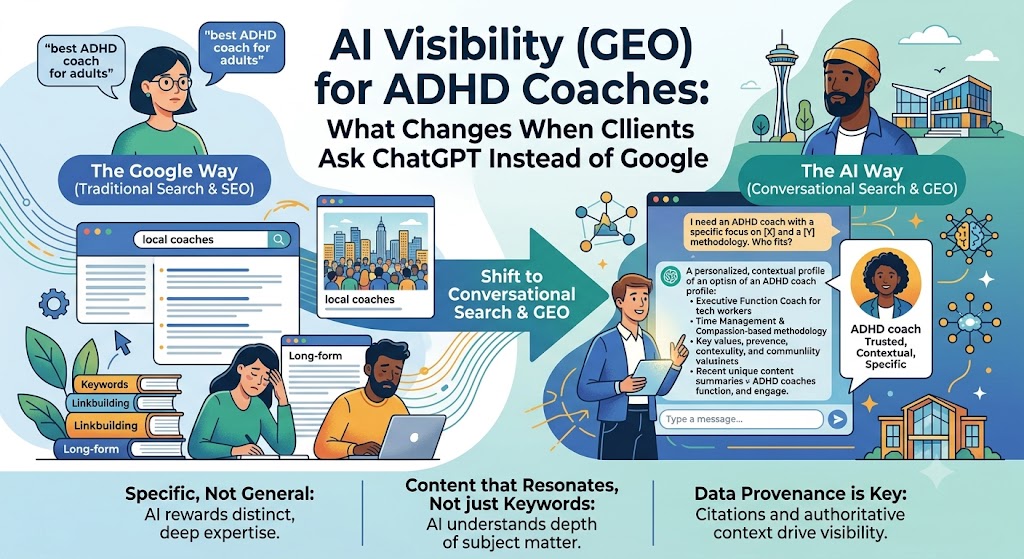
A growing share of the people who eventually book a discovery call with an ADHD coach never touch a Google results page at all. They open ChatGPT, Perplexity, or Gemini and type something like "find me an ADHD coach who actually understands executive function struggles," and they act on whatever name the model gives back. That shift is why AI visibility ADHD coach searches have started climbing among practitioners who used to worry only about Google rankings.
This piece breaks down what actually changes when your prospective clients search this way, why traditional SEO checklists only solve half the problem, and what generative engine optimization (GEO) for coaches really requires in practice. It's a longer read than most marketing advice you'll find on this topic, deliberately, because the shift itself deserves more than a surface-level explanation.
How ADHD Coaching Clients Actually Search Today
The search behaviour of neurodivergent clients has always looked a little different from the mainstream. Long, conversational queries, comparison-heavy phrasing, and a preference for direct answers over a wall of blue links are common patterns among people managing executive function load. AI chat interfaces reward exactly that kind of query, which is part of why adoption has moved faster in this audience than in many others.
Instead of typing "ADHD coach near me," a prospective client is more likely to ask a model to compare three coaches, summarize their specialties, or explain the difference between ADHD coaching and therapy. If your website isn't structured in a way a language model can parse and quote, you simply don't exist in that conversation — regardless of where you rank on Google.
It's worth being specific about why this matters for this audience in particular. Decision fatigue and analysis paralysis are common experiences for people with ADHD, and a single, synthesized AI answer removes a step that used to require opening ten tabs and comparing them manually. For many prospective clients, that convenience isn't optional — it's the reason they're using an AI assistant instead of a search engine in the first place.
What GEO for Coaches Actually Means
GEO for coaches is the practice of structuring your site, your content, and your public mentions so that AI models can accurately extract, summarize, and recommend you. It overlaps with SEO but isn't identical to it: Google's own Search Essentials guidelines still governs how Google crawls and indexes your pages, but the models powering AI answers weigh things like clear factual statements, consistent entity naming, and third-party corroboration more heavily than backlink volume alone.
For an ADHD coaching practice, that means your site needs unambiguous statements of who you serve, what modality you use, and what outcomes clients can expect — written in plain, quotable sentences rather than buried in stylized brand copy. A page that reads beautifully to a human visitor can still be nearly invisible to a model that's trying to extract a factual summary from it.
One practical distinction worth internalizing: SEO optimizes for a click. GEO optimizes for a citation. Those are different goals with overlapping but not identical tactics, and conflating them is the single most common mistake we see when practices try to tackle this on their own without a clear framework.
Why This Matters More for Coaches Than Generalist Practitioners
Coaching, unlike licensed therapy, has no standardized credentialing that AI models can lean on as a trust signal. That makes explicit, structured self-description on your own site even more important — the model has fewer external anchors to verify who you are and what you do.
This is also why directory listings and third-party mentions carry disproportionate weight for coaches specifically. Without a licensing board or professional registry to point to, your own site plus a handful of consistent, corroborating external mentions becomes the entire evidence base a model has to work with.
The AI Visibility Gap Most ADHD Coaches Don't Know They Have
Run the exercise yourself: open ChatGPT, Perplexity, and Gemini and ask each one "who is a good ADHD coach for adults with executive function challenges?" Most independent coaches discover they simply don't appear, even when they rank reasonably well on Google for related terms. That gap is the AI visibility problem in miniature.
This isn't a sign of a bad practice or weak marketing. It's a structural gap: the content that ranks well on Google (keyword-optimized landing pages) is often not the content that gets cited by AI models (clear, factual, well-corroborated statements about who you are). A coach can have excellent Google visibility and near-zero AI visibility at the same time, and most don't realize it until they run this exact test.
We've run this audit across dozens of practitioner sites in this space, and the pattern holds with remarkable consistency: the sites that do appear in AI answers are almost never the highest-ranking Google results. They tend to be sites with unusually clear, plainly stated service descriptions — often less polished visually, but far easier for a model to extract a confident answer from.
What Actually Improves AI Visibility for ADHD Coach Websites
Three levers move the needle fastest. First, add explicit FAQ-style content answering the exact questions prospective clients ask AI models — not just questions you'd ask a search engine. Second, make sure your bio, specialties, and credentials are stated identically across your site, your directory listings, and your social profiles; models cross-reference these for consistency. Third, add schema markup (Organization, Person, Service) so machines — not just humans — can parse who you are.
A fourth, less obvious lever is third-party corroboration. A guest article, a podcast appearance, or a mention in a credible publication that repeats your specialty in similar language to your own site gives a model an independent signal to weigh alongside your self-description, which noticeably increases the odds of an accurate citation.
Structured Content AI Models Can Actually Parse
Short declarative sentences outperform long narrative paragraphs when it comes to AI extraction. A line like "I coach adults with ADHD on time-blindness, task paralysis, and executive function planning" is more likely to be quoted back to a prospective client than three paragraphs of brand storytelling saying the same thing.
This doesn't mean your site has to sound robotic. It means the factual core of who you serve and how needs to exist somewhere on the page in plain, extractable form, even if the surrounding copy is warmer and more narrative in tone.
How to Start Auditing Your Own AI Visibility This Week
Before investing in a full GEO overhaul, run a simple baseline audit. Ask the major AI assistants five to ten realistic prospective-client questions and record exactly what comes back. This single exercise, borrowed from the audit process behind our neurodivergent-affirming SEO checklist, tells you more about your actual visibility gap than any keyword tool.
If you're also weighing whether a boutique specialist or a large generalist SEO firm is better positioned to close that gap, that's worth a separate look. Either way, don't skip the baseline step — it's the single cheapest, fastest way to know whether this is a real gap for your specific practice or a lower priority than other marketing work on your plate right now.
What This Looks Like for a Solo Practice Versus a Multi-Coach Practice
A solo coach has a natural advantage here: a single, consistent voice across the entire site is easier to maintain than across a team of coaches with varying specialties. Multi-coach practices need an extra layer of coordination to ensure each coach's bio, specialty description, and modality language stays internally consistent, since AI models are especially sensitive to contradictory information about the same organization appearing in different places.
For multi-coach practices specifically, consider a shared style reference document that every coach's bio and page content gets checked against before publishing, similar to an editorial style guide, so that consistency doesn't depend on informal memory across a growing team.
Common Mistakes Coaches Make Trying to Fix This Alone
The most common mistake is treating AI visibility as a one-time project rather than an ongoing practice. Models update, competitors publish new content, and directory listings drift out of sync over time, so a single audit and fix cycle tends to decay in effectiveness within a few months without follow-up.
A second common mistake is over-optimizing for a single AI platform. ChatGPT, Gemini, and Perplexity each weigh signals somewhat differently, and a coach who only checks their visibility on one platform can end up with an incomplete, sometimes misleading picture of where they actually stand.
A third mistake is neglecting the human-readability side entirely in the process. Content written purely to be machine-parseable, with no attention to how it reads to an actual prospective client, tends to convert poorly even when it succeeds at earning an AI citation — the citation gets you the introduction, but the page itself still has to do the work of building trust.
Key Takeaways
AI visibility isn't a replacement for SEO — it's an additional layer that rewards clarity, consistency, and structured factual content over keyword density alone. For ADHD coaches, closing this gap early is a meaningful advantage while most competitors are still focused exclusively on Google rankings, and the cost of getting started is genuinely low relative to the upside.
Frequently Asked Questions
What is GEO for coaches?
Generative engine optimization (GEO) is the practice of structuring your website and public content so AI assistants like ChatGPT and Gemini can accurately find, summarize, and recommend you to prospective clients.
Is AI visibility different from SEO?
Yes. SEO governs how you rank on Google's results page; AI visibility governs whether AI assistants cite or recommend you inside a conversational answer. The two overlap but require different tactics.
How do I check my current AI visibility as an ADHD coach?
Ask ChatGPT, Perplexity, and Gemini realistic prospective-client questions about ADHD coaching in your area or niche, and record whether — and how accurately — you appear.
Does schema markup actually help with AI visibility?
Structured data like Organization, Person, and Service schema gives AI crawlers an unambiguous, machine-readable summary of who you are, which reduces the chance of misattribution or omission.
Do I need to abandon traditional SEO to focus on GEO?
No — the two work together. Solid technical SEO and clear site structure still support crawlability, which is a prerequisite for AI models to find your content at all.
Why do ADHD coaching clients search differently than other audiences?
Many ADHD clients prefer direct, conversational answers over scanning multiple search results, which makes AI chat interfaces a natural fit and increases the importance of AI visibility for this niche specifically.
What's the fastest first step toward better AI visibility?
Add a clear, plainly worded FAQ section to your site answering the exact questions a prospective client would ask an AI assistant, using consistent language across all your online profiles.
How is this different from the SEO checklist Annurya offers?
The checklist covers foundational technical and on-page SEO; this article focuses specifically on the newer layer of AI-assistant visibility, which the checklist's audit step also touches on.
Should solo coaches worry about this or just larger practices?
Solo coaches arguably have the most to gain, since the near-zero competition in this specific niche means early, consistent action can establish visibility before larger competitors catch up.
How often should I re-check my AI visibility?
Quarterly is a reasonable cadence, since AI models update frequently and your competitive landscape in this niche is likely to shift faster than in more saturated markets.